In the intricate tapestry of human biology, few discoveries have held as profound an impact as the understanding of blood. For centuries, the crimson fluid coursing through our veins remained a mysterious life force, its true nature and variability hidden behind a veil of ancient superstition and limited scientific tools. Early attempts at blood transfusions, driven by desperation and a nascent understanding of circulation, were often perilous gambles, resulting in agonizing deaths that baffled physicians. The blood, it seemed, was both a giver of life and a harbinger of doom.
It was not until the dawn of the 20th century that the veil began to lift, revealing a hidden language within our very essence – the language of blood types. This revelation, spearheaded by the tireless work of Karl Landsteiner, didn’t just transform medicine; it rewrote our understanding of human individuality, genetic inheritance, and even our ancient migratory paths. This is the story of A, B, AB, and O – the silent sentinels that dictate compatibility, vulnerability, and, ultimately, our very survival.
The Dawn of Discovery: Karl Landsteiner’s Eureka Moment
Imagine a time when the simple act of giving blood was akin to Russian roulette. Patients suffering from massive blood loss would often die despite receiving transfusions, and the medical community was at a loss to explain why. Was it infection? Was the blood somehow "spoiled"? The prevailing theory was that all human blood was essentially the same.
Enter Karl Landsteiner, an Austrian physician and immunologist, whose meticulous curiosity would forever alter the course of medicine. Working in Vienna in 1900, Landsteiner observed a curious phenomenon: when he mixed blood samples from different individuals, sometimes the red blood cells would clump together, or "agglutinate," while at other times they would mix harmoniously. This clumping, he hypothesized, was not random. It was a reaction, a biological clash, suggesting fundamental differences between blood samples.
Landsteiner’s genius lay in his methodical approach. He systematically collected blood from himself and five of his colleagues, separated the red blood cells from the serum (the liquid component of blood), and then mixed serum from one person with red blood cells from another. His observations led him to identify three distinct patterns of agglutination, which he labeled A, B, and C. A year later, his students discovered a fourth, rarer type, which Landsteiner initially called ‘D’ but was later reclassified as AB. Type C was renamed O (for "ohne," meaning "without" in German, signifying the absence of certain antigens).
This was Landsteiner’s "eureka moment" – the realization that human blood was not monolithic but diverse, categorized by specific markers on the surface of red blood cells and corresponding antibodies in the plasma. For this groundbreaking work, which transformed transfusions from a deadly gamble into a life-saving procedure, Landsteiner was awarded the Nobel Prize in Physiology or Medicine in 1930. His discovery was not just a scientific breakthrough; it was a humanitarian triumph, paving the way for safe blood transfusions and countless saved lives.
The Language of Compatibility: Antigens and Antibodies
To truly understand blood types, we must delve into the fascinating molecular language they speak – the interplay of antigens and antibodies. Think of it like a biological identification system, a molecular passport that your red blood cells carry.
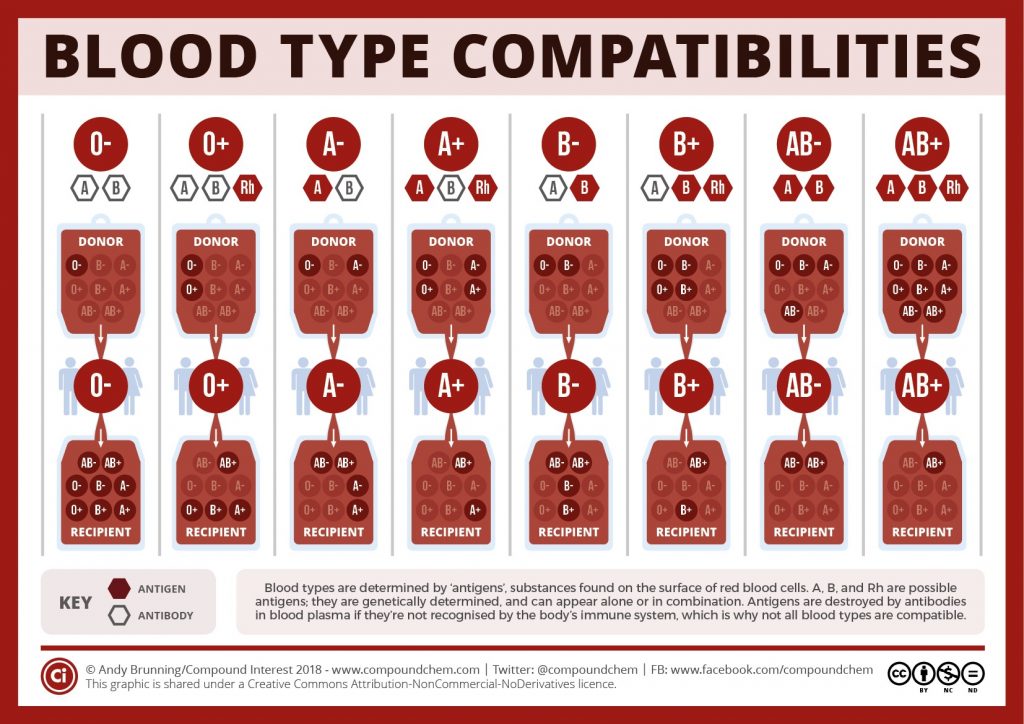
Antigens: These are specific protein or carbohydrate markers (like tiny flags) found on the surface of your red blood cells. They are genetically determined and act as identifiers. Your immune system recognizes your own antigens as "self."
Antibodies: These are specialized proteins produced by your immune system, found in your blood plasma. They are the body’s vigilant guards, designed to recognize and neutralize foreign invaders. Crucially, your body produces antibodies against any antigens that are not present on your own red blood cells. This is the core principle of blood type compatibility.
Let’s break down the ABO system:
- Type A Blood: Individuals with Type A blood have A antigens on the surface of their red blood cells. Because their body recognizes A antigens as "self," they naturally produce anti-B antibodies in their plasma. These anti-B antibodies are ready to attack any red blood cells carrying B antigens.
- Type B Blood: Individuals with Type B blood have B antigens on the surface of their red blood cells. Their immune system produces anti-A antibodies in their plasma, poised to attack any red blood cells carrying A antigens.
- Type AB Blood: This type is unique. Individuals with Type AB blood have both A antigens and B antigens on their red blood cells. Because both A and B are recognized as "self," their plasma contains neither anti-A nor anti-B antibodies. This makes AB individuals "universal recipients" in terms of ABO, as their blood won’t react against A or B antigens.
- Type O Blood: Individuals with Type O blood have neither A nor B antigens on their red blood cells. Lacking these identifiers, their immune system produces both anti-A antibodies and anti-B antibodies in their plasma. This makes Type O individuals "universal donors" in terms of ABO, as their red blood cells lack the antigens that would trigger a reaction in A, B, or AB recipients. However, their plasma cannot be given universally.
When incompatible blood types are mixed, the antibodies in the recipient’s plasma recognize the foreign antigens on the donor’s red blood cells. This triggers an immune response called agglutination, where the red blood cells clump together. This clumping can block blood vessels, leading to severe complications like kidney failure, shock, and ultimately, death. This is why careful cross-matching is paramount before any transfusion.
The Rh Factor: Another Layer of Complexity
Just when the ABO system seemed to bring clarity, another critical factor emerged to add further complexity: the Rhesus (Rh) factor. Discovered by Landsteiner and Alexander Wiener in 1940, the Rh factor is another type of antigen found on the surface of red blood cells.
- Rh Positive (Rh+): If your red blood cells have the Rh antigen, you are Rh positive. Approximately 85% of the population is Rh+.
- Rh Negative (Rh-): If your red blood cells lack the Rh antigen, you are Rh negative. Approximately 15% of the population is Rh-.
Unlike the ABO system, where antibodies are naturally present if the corresponding antigen is absent, anti-Rh antibodies are not naturally present in Rh- individuals. They are only produced if an Rh- person is exposed to Rh+ blood, typically through a mismatched transfusion or, more commonly and critically, during pregnancy.
The Rh factor’s most significant clinical implication lies in Rh incompatibility in pregnancy. If an Rh- mother carries an Rh+ baby (inherited from the father), her immune system can become sensitized during birth or if fetal blood mixes with hers (e.g., during miscarriage, abortion, or trauma). Her body may then produce anti-Rh antibodies. In subsequent pregnancies with another Rh+ baby, these maternal antibodies can cross the placenta and attack the fetal red blood cells, leading to Hemolytic Disease of the Newborn (HDN), a severe and potentially fatal condition characterized by anemia, jaundice, and organ damage in the baby.
Fortunately, medical science has developed a life-saving solution: RhoGAM (Rh immunoglobulin). Administered to Rh- mothers during pregnancy and after delivery (or other sensitizing events), RhoGAM prevents the mother’s immune system from producing anti-Rh antibodies, thereby protecting future Rh+ babies. This prophylactic treatment has virtually eliminated HDN as a major cause of infant mortality in developed nations.