The humble carrot, with its vibrant orange hue, has long been synonymous with good vision and health. Ask anyone about the benefits of this root vegetable, and "beta-carotene" and "eyesight" will likely be the immediate responses. While this association is undeniably true and important, it barely scratches the surface of a vast and intricate biochemical saga. The story of carotenoids, the class of pigments to which beta-carotene belongs, is far richer and more complex, extending into the very core of our cellular machinery and influencing a breathtaking array of physiological processes.
These lipid-soluble pigments, responsible for the fiery reds of tomatoes, the sunny yellows of corn, and the deep greens masked by chlorophyll in spinach, are far more than mere colorants. They are potent biological modulators, orchestrating a symphony of molecular events that contribute to human health in ways we are only beginning to fully comprehend. To view carotenoids solely through the lens of vision is akin to appreciating only a single note in a grand opera. This article embarks on a journey to unravel the diverse molecular benefits of carotenoids, moving beyond the familiar narrative to explore their profound impact at a cellular and genetic level.
The Chemical Tapestry: An Introduction to Carotenoid Diversity
At their heart, carotenoids are a family of over 600 naturally occurring tetraterpenoid pigments synthesized by plants, algae, and some fungi and bacteria. Animals, including humans, lack the enzymatic machinery to produce carotenoids de novo, making them essential dietary components. Their characteristic colors, ranging from yellow to red, arise from an extended system of conjugated double bonds within their polyene chain structure, allowing them to absorb specific wavelengths of light.
This vast family is broadly categorized into two main groups:
-
Carotenes: These are pure hydrocarbons, meaning they contain only carbon and hydrogen. Key examples include:
- Beta-carotene: The most well-known provitamin A carotenoid, found abundantly in carrots, sweet potatoes, and leafy greens. It can be cleaved to form two molecules of retinal (Vitamin A).
- Alpha-carotene: Also a provitamin A carotenoid, less common than beta-carotene, found in similar sources.
- Lycopene: The predominant red pigment in tomatoes, watermelon, and grapefruit. It is not a provitamin A carotenoid.
-
Xanthophylls: These are oxygenated derivatives of carotenes, containing oxygen atoms in their molecular structure, often as hydroxyl groups. Important xanthophylls include:
- Lutein: Abundant in leafy green vegetables like spinach and kale, and egg yolks. Not a provitamin A carotenoid.
- Zeaxanthin: Often found alongside lutein, particularly concentrated in the macula of the eye. Not a provitamin A carotenoid.
- Beta-cryptoxanthin: Found in oranges, tangerines, and papaya. It is a provitamin A carotenoid.
- Astaxanthin: A reddish pigment found in marine organisms like salmon, shrimp, and microalgae. It is renowned for its potent antioxidant capacity and is not a provitamin A carotenoid.
This structural diversity dictates their unique physical properties, bioavailability, tissue distribution, and ultimately, their distinct biological functions. While some share common mechanisms, others exert highly specialized effects, painting a complex and fascinating picture of their physiological roles.
The Journey Within: From Plate to Cellular Command Center
The molecular benefits of carotenoids begin with their journey through the human body, a meticulously orchestrated process of absorption, transport, metabolism, and tissue distribution. This journey profoundly influences their ultimate bioavailability and bioactivity.
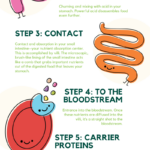
Upon ingestion, carotenoids, being fat-soluble, require dietary fat for efficient absorption. In the stomach and small intestine, they are released from the food matrix and emulsified by bile salts, forming mixed micelles. These micelles facilitate their uptake by enterocytes (intestinal cells), primarily through transporter proteins such as scavenger receptor class B type 1 (SR-B1) and CD36, though passive diffusion also plays a role.
Once inside the enterocytes, carotenoids are packaged into chylomicrons, lipoprotein particles that are then secreted into the lymphatic system and eventually enter the bloodstream. These chylomicrons deliver carotenoids to various tissues. The liver is a central hub, taking up chylomicron remnants and repackaging carotenoids into very-low-density lipoproteins (VLDLs) for further distribution to peripheral tissues.