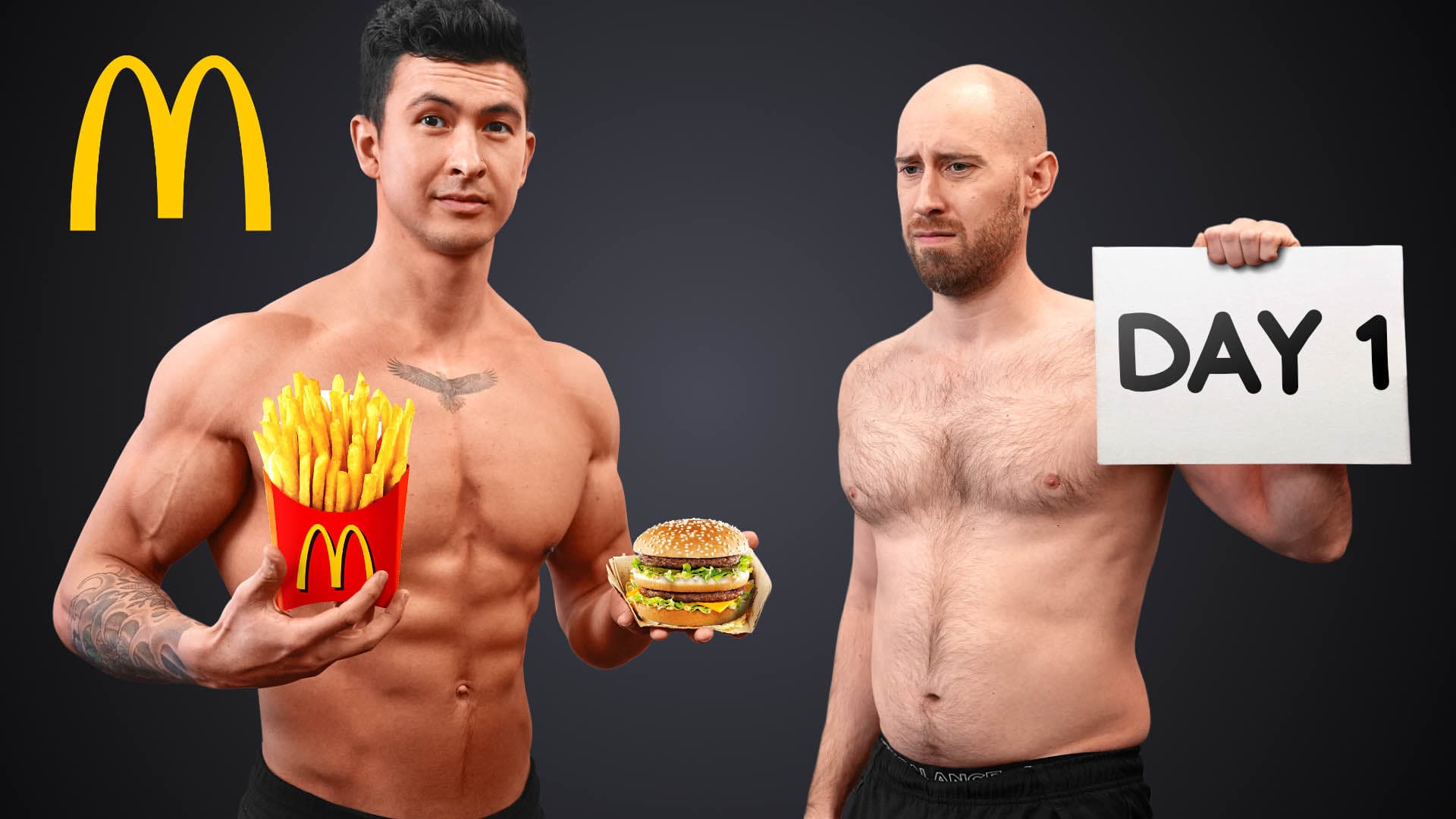
The golden arches loom large in our collective consciousness, a ubiquitous symbol of convenience, speed, and, for many, dietary indulgence. For decades, McDonald’s has been cast as the antagonist in the story of health and wellness, a purveyor of "unhealthy" foods contributing to the global obesity crisis. From the grim portrayal in Morgan Spurlock’s "Super Size Me" to countless nutritionists’ warnings, the narrative has been clear: fast food equals weight gain, ill health, and a slippery slope to metabolic distress.
But what if the story isn’t quite so straightforward? What if, buried beneath layers of public perception and nutritional dogma, there lay a counter-narrative, a provocative challenge to everything we thought we knew? The question itself sounds like a paradox, an oxymoron: Can you really lose weight on a McDonald’s-only diet?
The immediate, visceral reaction for most is an emphatic "No!" But for those who delve deeper into the complex tapestry of human metabolism, dietetics, and psychology, the answer, surprisingly, morphs into a nuanced, "Yes, but it’s far more complicated than simply picking up a Big Mac." This isn’t just about calories; it’s a profound exploration of scientific principles, human behavior, societal pressures, and the very definition of "health." It’s a story that reveals the limitations of our food classifications and the enduring power of fundamental biological laws.
The Unbreakable Law: Calories In, Calories Out
At the heart of any discussion about weight loss lies an immutable scientific truth, a principle as fundamental to biology as gravity is to physics: the law of thermodynamics applied to the human body. Simply put, to lose weight, you must consume fewer calories than your body expends. This is the Calorie Deficit Principle, often abbreviated as CICO (Calories In, Calories Out).
Every morsel of food we consume contains energy, measured in calories. Our bodies burn calories constantly, even at rest, for basic functions like breathing, circulation, and maintaining body temperature (our Basal Metabolic Rate or BMR). On top of this, we expend calories through physical activity, from walking to intense exercise, and even through the digestion of food (the Thermic Effect of Food or TEF). If the total calories consumed consistently fall below the total calories expended, the body taps into its stored energy reserves, primarily fat, leading to weight loss. Conversely, if calories in exceed calories out, weight is gained.
This principle is indifferent to the source of those calories. A calorie from broccoli is chemically and energetically the same as a calorie from a Big Mac. While the nutritional impact and metabolic response to these calories might differ significantly, their fundamental energy value remains constant. This is the critical insight that underpins the possibility of losing weight on a McDonald’s diet. If one carefully selects items from the McDonald’s menu to create a consistent calorie deficit, weight loss will, by scientific necessity, occur.
The initial shock of this statement often stems from our ingrained categorization of foods as "good" or "bad." We instinctively label fast food as "bad" and thus inherently fattening. However, this is a dangerous oversimplification. While many fast-food items are calorie-dense and nutritionally sparse, making it easier to overconsume calories and harder to meet nutritional needs, their mere existence does not defy the laws of thermodynamics. The challenge, therefore, is not in the calorie content itself, but in the meticulous management required to stay within a deficit using such a menu.
The Anecdotal Evidence: Two Sides of a Golden Coin
To truly grasp the complexities of this dietary experiment, we must turn to the real-world stories that have ignited public debate and scientific curiosity. These narratives, often presented as stark contrasts, illustrate the pivotal role of calorie management and individual methodology.
The "Super Size Me" Saga: A Cautionary Tale of Excess
Our collective memory often first conjures the image of Morgan Spurlock, the filmmaker behind the 2004 documentary "Super Size Me." Spurlock’s experiment was simple, yet profoundly impactful: for 30 days, he would eat nothing but McDonald’s, consuming every item on the menu at least once, and "super size" his meal if offered. Crucially, he committed to no exercise. The results were dramatic and disturbing: he gained 24.5 pounds, his cholesterol levels skyrocketed, he experienced severe mood swings, and his liver suffered significant damage, alarming his doctors.
Spurlock’s documentary cemented McDonald’s image as an antagonist to health, a purveyor of foods that rapidly destroy the body. And for good reason: his experiment undeniably demonstrated the dangers of overconsumption of calorie-dense, nutrient-poor foods combined with a sedentary lifestyle. It was a potent indictment not of McDonald’s per se, but of unchecked indulgence and the absence of any caloric or nutritional self-awareness. It served as a powerful illustration of what happens when calories in vastly exceed calories out, particularly when those calories come from sources that offer little satiety for their energetic load.
John Cisna: The Unlikely McDonald’s Diet Success Story
But then there’s the lesser-known, yet equally compelling, counter-narrative of John Cisna. In 2014, Cisna, a high school science teacher from Iowa, embarked on his own 90-day McDonald’s diet. His motivation was to teach his students a practical lesson about choice, personal responsibility, and the calorie deficit principle, directly challenging the prevailing narrative exemplified by "Super Size Me."
Unlike Spurlock, Cisna’s approach was meticulously controlled. He limited his daily intake to 2,000 calories, a figure close to the recommended daily allowance for an adult male, and ensured he met the recommended daily allowances for 15 essential nutrients. He worked with a dietitian to select menu items that would allow him to hit these targets, often opting for items like Egg McMuffins, salads (with careful dressing choices), grilled chicken sandwiches, and even a small Big Mac or Quarter Pounder. Crucially, he also incorporated a 45-minute walk five times a week.
The results? Cisna lost 37 pounds and saw significant improvements in his health markers, including a drop in his cholesterol levels. His story, while less publicized than Spurlock’s, offered a stark, empirical rebuttal: it wasn’t the McDonald’s food itself that was inherently "fattening," but the manner in which it was consumed. Cisna’s experiment was a testament to the supremacy of the calorie deficit principle, demonstrating that even a menu commonly associated with weight gain could facilitate weight loss if managed rigorously.
These two narratives, side by side, tell a powerful story. Spurlock’s tale is one of unbridled excess and its inevitable consequences. Cisna’s is one of disciplined adherence to scientific principles and the surprising outcomes that can emerge from challenging conventional wisdom. Both, however, underscore the fundamental truth: weight loss or gain is overwhelmingly dictated by energy balance.
Beyond Calories: Navigating the Nutritional Minefield
While John Cisna’s story provides compelling evidence that weight loss is possible on a McDonald’s-only diet, it also inadvertently highlights the immense challenges and potential pitfalls that extend far beyond mere calorie counting. For a truly knowledgeable audience, understanding the full picture requires dissecting the nutritional landscape of such a diet – a landscape that is, frankly, a minefield of deficiencies and excesses.
Macronutrients: A Juggling Act
- Protein: Protein is crucial for satiety, muscle preservation during weight loss, and various bodily functions. While McDonald’s offers sources like grilled chicken, eggs, and beef patties, a diet solely reliant on these would require conscious effort to meet adequate protein targets without significantly overshooting calories from other sources. Many popular items are relatively low in protein compared to their calorie count.
- Fats: Fast food is notoriously high in fat, particularly saturated and trans fats. While fats are essential for hormone production and nutrient absorption, excessive intake of unhealthy fats raises concerns about cardiovascular health, cholesterol levels, and inflammation. Navigating a McDonald’s menu to keep fats within healthy limits while maintaining a calorie deficit is incredibly difficult. Fries, burgers, fried chicken, and many sauces are laden with fats that, while providing energy, offer little in the way of beneficial polyunsaturated or monounsaturated varieties.
- Carbohydrates: The carbohydrates in a typical McDonald’s diet tend to be refined – white buns, sugary drinks, fried potatoes. These carbohydrates are rapidly digested, leading to quick spikes in blood sugar and insulin, followed by potential crashes that can trigger cravings. While carbohydrates are the body’s primary energy source, a diet dominated by refined carbs, rather than complex carbohydrates from whole grains, fruits, and vegetables, can lead to unstable energy levels and a lack of sustained satiety.
Micronutrients: The Glaring Deficiencies
This is where a McDonald’s-only diet truly falters, even if calories are perfectly managed. Micronutrients – vitamins and minerals – are vital for virtually every bodily process, from immune function and bone density to energy production and cellular repair.