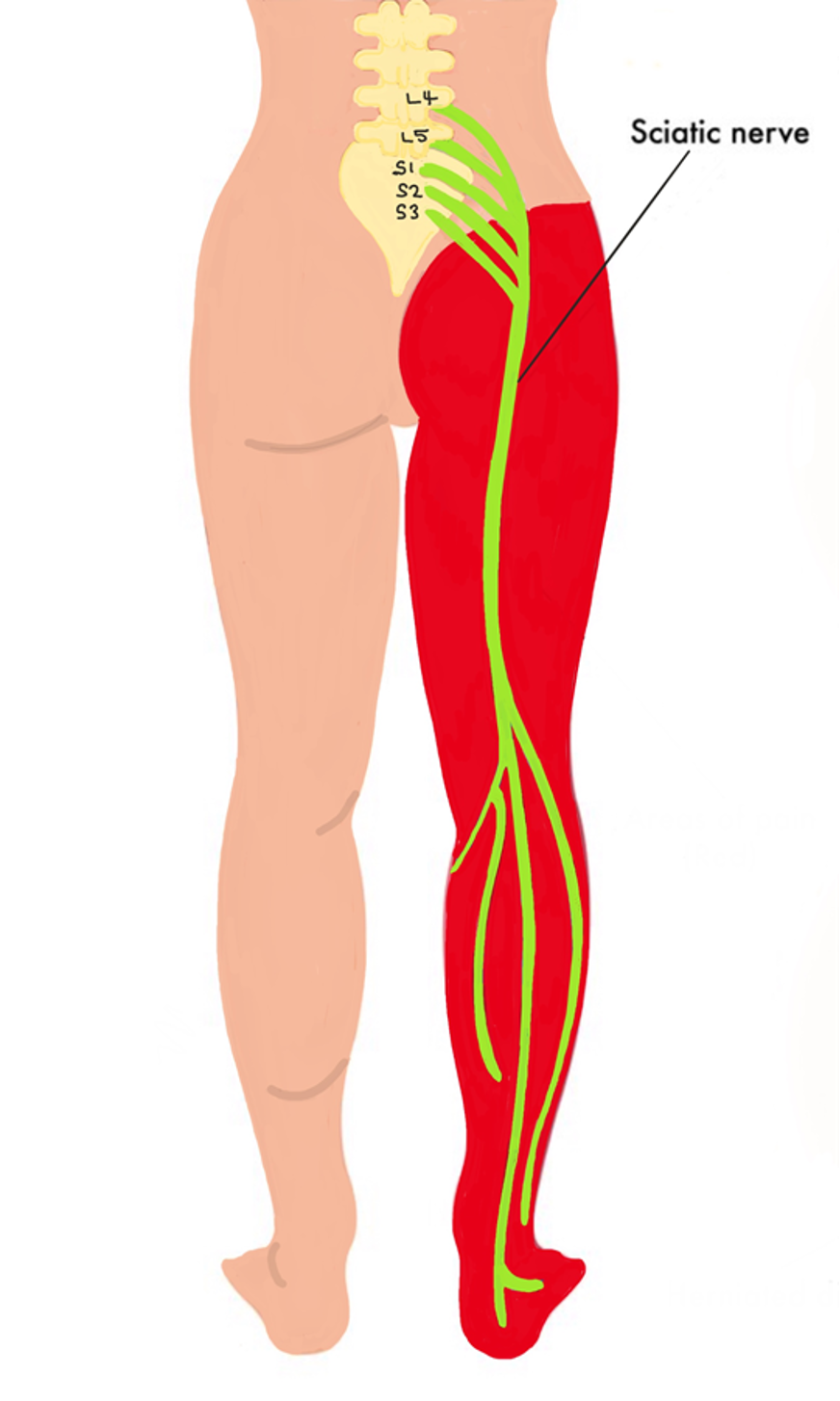
In the intricate tapestry of the human body, few threads are as long, as vital, and yet as prone to causing profound distress as the sciatic nerve. It is a biological superhighway, a grand conductor of sensation and movement, originating deep within the lumbar spine and extending its tendrils all the way to your toes. For many, its existence remains an abstract concept until it announces itself with a searing, undeniable declaration: sciatica.
This is not merely an anatomical guide; it is the story of your sciatic nerve. It’s a narrative that traces its majestic journey from its hidden origins, through its critical functions, into the tumultuous chapters of pain and dysfunction, and finally, towards understanding, healing, and resilience. For the knowledgeable reader, eager to delve beyond the superficial, this guide aims to illuminate every facet of this remarkable, sometimes rebellious, nerve.
Part I: The Grand Anatomy – Our Body’s Longest Nerve
To truly understand the drama of sciatica, we must first appreciate the protagonist: the sciatic nerve itself. Imagine a tree, deeply rooted in the lower spine, its trunk thickening before branching out extensively.
1. Origins: The Lumbar Plexus and Sacral Plexus – A Confluence of Power
The sciatic nerve doesn’t spring from a single root. Instead, it is a magnificent amalgamation of several smaller nerve roots emerging from the spinal cord. Specifically, it forms from the anterior rami (ventral divisions) of the spinal nerves L4, L5, S1, S2, and S3. These individual roots converge within the pelvis, forming what is known as the sacral plexus, a complex network of nerves. It’s here, deep within the buttock, that these fibers unite to form the thickest and longest nerve in the human body.
2. The Grand Descent: From Pelvis to Toes
Once formed, the sciatic nerve embarks on its epic journey.
- Through the Pelvis: It typically exits the pelvis through the greater sciatic foramen, usually passing below the piriformis muscle. (The variation where it passes through or above the piriformis is a critical detail we’ll revisit later).
- The Buttock: It then courses downwards, deep beneath the gluteal muscles.
- The Thigh: It continues its descent down the posterior aspect of the thigh, nestled between the hamstring muscles (biceps femoris, semitendinosus, semimembranosus).
- The Popliteal Fossa: Just above the knee, in the diamond-shaped space behind the knee known as the popliteal fossa, the sciatic nerve typically bifurcates (splits) into its two major terminal branches:
- The Tibial Nerve: This larger branch continues straight down the back of the leg, supplying the muscles of the posterior lower leg (calf muscles, deep flexors) and sensation to the sole of the foot.
- The Common Fibular (Peroneal) Nerve: This branch wraps around the head of the fibula (the smaller bone of the lower leg) and then further divides into the superficial fibular nerve and the deep fibular nerve. These branches supply the muscles that lift the foot (dorsiflexion) and evert it (turn it outwards), as well as sensation to the top of the foot and parts of the lower leg.
3. Functional Imperatives: What the Sciatic Nerve Does
The sciatic nerve is a mixed nerve, meaning it carries both motor and sensory fibers. Its extensive reach ensures it plays a crucial role in:
- Motor Function: It innervates nearly all the muscles in the back of the thigh (hamstrings), and all the muscles below the knee in both the anterior, lateral, and posterior compartments of the lower leg. This means it’s essential for:
- Flexing the knee (hamstrings)
- Extending the hip (hamstrings)
- Plantarflexing the foot (pointing toes down, calf muscles)
- Dorsiflexing the foot (lifting toes up)
- Inverting and everting the foot
- Flexing the toes