In the intricate tapestry of the human body, there are centers of immense power and profound mystery, places where the physical and the intangible converge. Among these, perhaps none is as evocative, as deeply felt, and yet as often misunderstood, as the region we commonly refer to as the Solar Plexus. It is an internal sun, radiating energy, warmth, and influence throughout our being, a silent conductor orchestrating a symphony of life within our core. To truly understand it is to embark on a journey that transcends mere anatomy, delving into physiology, history, spirituality, and the very essence of human experience.
This is the story of the Solar Plexus, also known by its precise anatomical designation, the Celiac Plexus – a tale of a complex nerve network that is simultaneously a vital biological hub, a historical touchstone, and a powerful energetic center. It is a narrative woven from scientific discovery, ancient wisdom, and the universal language of human emotion, revealing how this seemingly obscure bundle of nerves is, in fact, a crucial nexus of our physical and psychological well-being.
Chapter 1: Unveiling the Anatomical Masterpiece – The Scientific Genesis
Our journey begins in the quiet, hidden depths of the abdomen, where the Solar Plexus, or Celiac Plexus, lies nestled. Imagine a grand central station for nerves, a densely packed metropolis of neural pathways, strategically positioned at the crossroads of vital organs. This is its anatomical reality, a marvel of biological engineering designed for communication and control.
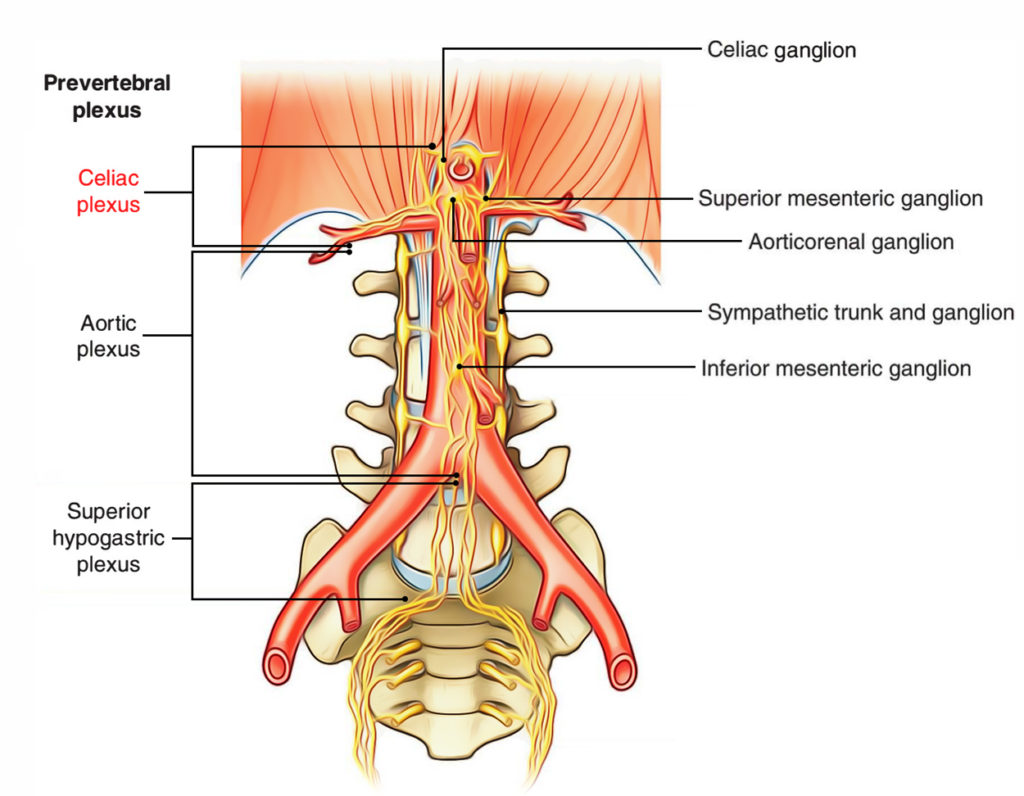
Location, Location, Location: To pinpoint its exact whereabouts, we must look to the upper abdomen. The Celiac Plexus resides just behind the stomach, situated anterior to the aorta (the body’s largest artery) and the crura of the diaphragm (the muscular pillars that anchor the diaphragm to the spine). It is intimately associated with the celiac artery, from which it derives part of its name, and lies superior to the pancreas, often nestled near the adrenal glands and kidneys. This strategic placement grants it dominion over a vast internal landscape.
The Network’s Architecture: Far from being a single, isolated structure, the Celiac Plexus is a complex, diffuse network of interconnected ganglia (clusters of nerve cell bodies) and nerve fibers. The primary players in this neural orchestra are the paired celiac ganglia, which are the largest components. These are often joined by the superior mesenteric ganglion and the aorticorenal ganglia, forming a formidable interconnected web. Each ganglion acts like a mini-relay station, receiving signals, processing them, and then dispatching instructions. The sheer density and complexity of this arrangement are breathtaking, a testament to its critical role.
The Nerve Pathways: An Inflow of Information: What feeds into this central station? The Celiac Plexus receives its rich supply of information from several major nerves. The most significant are the splanchnic nerves, particularly the greater, lesser, and least splanchnic nerves, which originate from the sympathetic division of the autonomic nervous system in the thoracic spinal cord (typically T5 to T12 vertebral levels). These nerves carry sympathetic (fight or flight) signals, preparing the body for action. In addition, branches of the vagus nerve (cranial nerve X), part of the parasympathetic (rest and digest) division, also contribute fibers, bringing a calming, restorative influence. This dual innervation highlights the plexus’s role as a primary coordinator of the body’s involuntary functions, balancing activation and relaxation.
The Target Organs: A Sphere of Influence: From this central hub, a vast array of nerve fibers radiate outwards, like the rays of a sun – hence the "solar" moniker. These efferent (outgoing) nerves extend their reach to almost all the abdominal viscera. Consider the sheer scope:
- Digestive System: The stomach, duodenum, jejunum, ileum, ascending colon, and proximal transverse colon, along with accessory digestive organs like the liver, gallbladder, and pancreas. The plexus meticulously regulates their motility, secretion of digestive juices, and blood flow.
- Urinary System: The kidneys, influencing blood filtration and urine production.
- Endocrine System: The adrenal glands, playing a critical role in the stress response by modulating the release of hormones like adrenaline and cortisol.
- Circulatory System: Vasomotor control over the blood vessels supplying these organs, ensuring appropriate blood flow during varying physiological demands.
- Spleen: Involved in immune function and blood filtration.
This extensive innervation underscores the Celiac Plexus’s role as a master regulator, a silent conductor ensuring the harmonious operation of our most vital internal systems.
The Sympathetic and Parasympathetic Dance: At its core, the Celiac Plexus is a major relay station for the autonomic nervous system (ANS), the involuntary control system of the body. It beautifully illustrates the constant dance between the sympathetic and parasympathetic branches. The sympathetic fibers, arriving via the splanchnic nerves, generally accelerate functions (e.g., increasing heart rate, diverting blood from digestion during stress), while the parasympathetic fibers, carried by the vagus nerve, generally slow down and conserve energy (e.g., promoting digestion, reducing heart rate). The Celiac Plexus integrates these opposing forces, making split-second decisions to maintain internal equilibrium, a state known as homeostasis. When you feel a "knot" in your stomach during anxiety, or the rush of adrenaline during fear, it is often this intricate system at work, mediating your body’s physiological response to your inner world.
Chapter 2: The Symphony of Function – A Physiological Narrative
With its anatomical blueprint now understood, we can begin to tell the story of what the Solar Plexus does. It is not merely a collection of wires and relays; it is a dynamic, responsive entity that profoundly impacts our moment-to-moment experience of life. It acts as a physiological maestro, guiding a complex internal symphony.
Digestion’s Conductor: One of its most fundamental roles is in the regulation of digestion. Imagine the journey of a meal: from the moment it enters the stomach, through the intricate processes of breaking down nutrients, absorbing them, and eliminating waste. The Celiac Plexus is deeply involved in controlling the peristaltic movements (the wave-like contractions that propel food), the secretion of enzymes and acids, and the precise blood flow needed for optimal absorption in various digestive organs. When you feel a pang of hunger, a growl in your stomach, or the discomfort of indigestion, the plexus is often at the heart of these sensations, responding to internal cues and external stressors.
The Metabolic Maestro: Beyond digestion, the Solar Plexus holds sway over crucial metabolic processes. It innervates the pancreas, influencing the release of insulin and glucagon, hormones vital for blood sugar regulation. It also communicates with the liver, a metabolic powerhouse involved in detoxification, nutrient processing, and energy storage. Furthermore, its connection to the adrenal glands means it plays a direct role in the release of stress hormones like cortisol and adrenaline. This makes it an integral part of the body’s energy management system, determining how efficiently we use and store fuel, and how we respond to energetic demands.
Blood Flow Regulation: The meticulous control of blood flow to the abdominal viscera is another key function. During digestion, more blood is shunted to the gut; during stress or physical exertion, blood might be diverted to muscles. The Celiac Plexus, through its sympathetic innervation of blood vessels, acts as a sophisticated traffic controller, ensuring that each organ receives the appropriate supply of oxygen and nutrients at the right time, adapting to the body’s ever-changing needs.
Pain Perception and Processing: The Gut Feeling of Discomfort: The Solar Plexus is also a significant center for pain perception in the abdominal region. Its dense network of sensory nerves makes it highly sensitive to inflammation, distension, or injury in the organs it innervates. This explains why conditions like pancreatitis, gallstones, or even severe emotional stress can manifest as intense, diffuse, or radiating pain in the upper abdomen. The "gut feeling" of pain is often a direct communication from this central hub, signaling distress. For patients suffering from intractable abdominal pain, particularly in cancer, celiac plexus blocks are a testament to its role as a major pain pathway, highlighting its capacity to convey profound discomfort.
The Stress Response Hub: A Knot in the Stomach: Perhaps the most relatable and universally experienced function of the Solar Plexus is its role as a primary mediator of the stress response. This is where the scientific narrative deeply intertwines with our lived experience. When we face fear, anxiety, excitement, or profound emotional distress, the sympathetic nervous system kicks into high gear. The splanchnic nerves fire, sending signals to the Celiac Plexus, which then relays them to the adrenal glands, triggering the release of adrenaline and noradrenaline. This cascade leads to the familiar physical sensations of stress: butterflies in the stomach, a sudden emptying of the bowels, nausea, or that characteristic "knot" or tightness in the abdomen.
The Solar Plexus acts as a physical manifestation of our emotional state. It processes and translates psychological stress into physiological symptoms. It is the reason why a sudden shock can literally take our breath away, or why chronic anxiety can lead to persistent digestive issues. It serves as a barometer of our inner turmoil, constantly reacting to our thoughts, feelings, and external pressures.
Interoception: Our Internal Awareness: Finally, the Solar Plexus contributes significantly to interoception, our sense of the internal state of our body. It’s the subtle awareness of our heart rate, our breathing, our gut sensations – the background hum of our physiological existence. This internal awareness is crucial for self-regulation and emotional intelligence. When the Solar Plexus is disturbed, this internal dialogue can become muddled, leading to a sense of disconnect or chronic discomfort.
In essence, the Celiac Plexus is not merely a collection of nerves; it is a dynamic, responsive entity that bridges our inner emotional world with our outer physical manifestations, a silent narrator of our body’s ongoing story.
Chapter 3: Echoes Through Time – Historical and Cultural Perspectives
The story of the Solar Plexus is not just a modern scientific one; its significance has resonated through human cultures and medical understanding for centuries, albeit under different names and interpretations. It has been implicitly recognized as a vital center, a seat of power and emotion, long before the advent of neuroanatomy.