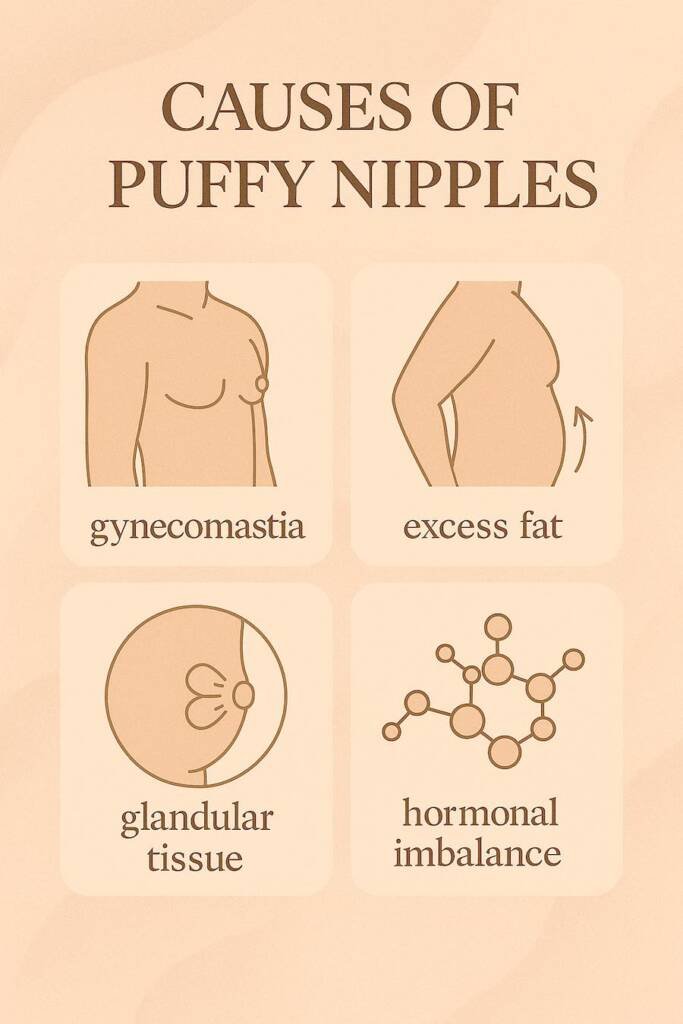
The human body is a canvas of constant change, a living testament to the intricate interplay of biology, environment, and the relentless march of time. Among its myriad forms, the breast, and particularly the nipple-areola complex, stands as a uniquely sensitive and symbolically charged region. For many, a sudden or persistent puffiness of the nipples can be a source of immediate concern, a subtle shift in familiar topography that triggers curiosity, apprehension, or even alarm. Yet, the story behind a puffy nipple is rarely one of singular drama; more often, it is a nuanced narrative woven from the threads of common physiological processes, hormonal fluctuations, and lifestyle influences.
This exploration invites the knowledgeable reader on a journey beyond superficial observation, delving into the biological underpinnings of six common causes behind this often-perplexing phenomenon. We aim not just to list, but to understand the mechanisms, the contexts, and the broader implications, recognizing that the body’s signals are always part of a larger, ongoing dialogue.
I. The Hormonal Odyssey: The Puberty Nexus
The transition from childhood to adolescence is a tumultuous, yet profoundly transformative period, orchestrated by a symphony of hormones that redefine the body’s landscape. For many, both male and female, the onset of puberty marks the first encounter with puffy nipples, a phenomenon often dismissed as an awkward, temporary phase, but one rooted in powerful endocrine shifts.
The Biological Ballet of Adolescence:
Puberty is fundamentally driven by the activation of the hypothalamic-pituitary-gonadal (HPG) axis. In both sexes, the hypothalamus releases Gonadotropin-Releasing Hormone (GnRH), which stimulates the pituitary gland to secrete Luteinizing Hormone (LH) and Follicle-Stimulating Hormone (FSH). These gonadotropins then act on the gonads – the ovaries in females and the testes in males – to produce sex steroids.
In females, the surge in estrogen is the primary architect of breast development, a process known as thelarche. Estrogen stimulates the growth and branching of the mammary ducts, increases the amount of stromal tissue, and promotes the deposition of adipose (fat) tissue within the breast. The nipple-areola complex, being highly sensitive to estrogen, often responds with increased vascularity, pigmentation, and a noticeable puffiness or swelling as the underlying ductal system expands and the surrounding connective tissue and fat accumulate. This early development, sometimes asymmetrical, can lead to transient nipple prominence.
For adolescent males, the narrative takes a slightly different turn, often bordering on social discomfort. While testosterone is the dominant male sex hormone, puberty also involves a rise in estrogen levels, albeit to a lesser extent than in females. This estrogen can originate from two main sources: direct testicular production or, more commonly, from the peripheral conversion of androgens (like testosterone) into estrogens by an enzyme called aromatase, primarily located in adipose tissue.
Transient Pubertal Gynecomastia:
This temporary imbalance, where estrogenic effects temporarily outweigh androgenic effects on breast tissue, is the physiological basis for pubertal gynecomastia. The male breast, though rudimentary, still contains estrogen receptors. When stimulated by elevated estrogen, the glandular tissue beneath the nipple can proliferate, leading to a palpable, sometimes tender, lump and a visibly puffy nipple. This condition is remarkably common, affecting up to 70% of adolescent boys, usually peaking between 13 and 14 years of age. While often self-resolving within 6 months to 2 years as the testosterone-to-estrogen ratio stabilizes, its psychological impact can be significant, highlighting the sensitive relationship between bodily changes and self-perception during formative years.
The puffiness observed during puberty, therefore, is not a deviation but often a natural, albeit sometimes uneven, manifestation of the body’s rapid growth and hormonal re-calibration. It is a testament to the potent influence of sex steroids on specialized tissues, a prelude to the complex hormonal landscapes that will continue to shape the body throughout life.
II. The Female Hormonal Symphony: Menstruation, Pregnancy, and Perimenopause
Beyond the dramatic shifts of puberty, the female body continues its cyclical dance with hormones, a rhythm that profoundly impacts the breast tissue and, by extension, the nipples. These predictable, yet often uncomfortable, fluctuations are a leading cause of nipple puffiness throughout a woman’s reproductive life and into her later years.
The Menstrual Cycle: A Monthly Overture:
The menstrual cycle is a meticulously choreographed sequence of hormonal events designed to prepare the uterus for potential pregnancy. Its influence, however, extends far beyond the reproductive organs, notably affecting the breasts.
- Follicular Phase: During the first half of the cycle, estrogen levels rise steadily, stimulating ductal growth and proliferation in the breast.
- Luteal Phase: After ovulation, both estrogen and progesterone levels surge. Progesterone, produced by the corpus luteum, stimulates the lobular development within the breast and promotes fluid retention. This combined hormonal onslaught – high estrogen driving ductal growth and high progesterone encouraging lobular development and fluid accumulation – leads to increased breast volume, tenderness, and often, visibly puffy and sensitive nipples in the days leading up to menstruation. This premenstrual breast engorgement and nipple changes are a classic symptom of premenstrual syndrome (PMS) and are a direct consequence of the cyclical hormonal tide. The increased fluid retention and tissue expansion within the nipple and areola contribute directly to their swollen appearance.
Pregnancy: The Grand Crescendo of Preparation:
Pregnancy represents an unparalleled hormonal milieu, designed to transform the female body into a nurturing environment. The breasts undergo profound changes, preparing for lactation, and nipple puffiness is an almost universal accompaniment to this metamorphosis.
From the earliest weeks of conception, estrogen and progesterone levels skyrocket, produced initially by the corpus luteum and later by the placenta.
- Estrogen: Drives the extensive growth of the mammary ducts.
- Progesterone: Promotes the proliferation of the glandular lobules and alveoli, the milk-producing units.
- Prolactin: Produced by the pituitary gland, prolactin levels also rise, further stimulating glandular development and preparing the breasts for milk production.
- Human Chorionic Gonadotropin (hCG): This hormone, the basis of pregnancy tests, also contributes to early breast tenderness and nipple changes.
The combined effect of these hormones leads to a dramatic increase in breast size, density, and vascularity. The nipples and areolas become larger, darker, and more prominent, often appearing significantly puffy due to the underlying expansion of the ductal system, increased blood flow, and the development of Montgomery glands (sebaceous glands that appear as small bumps on the areola, providing lubrication). This puffiness is not merely cosmetic; it is a functional adaptation, preparing the nipples for the demands of breastfeeding.